
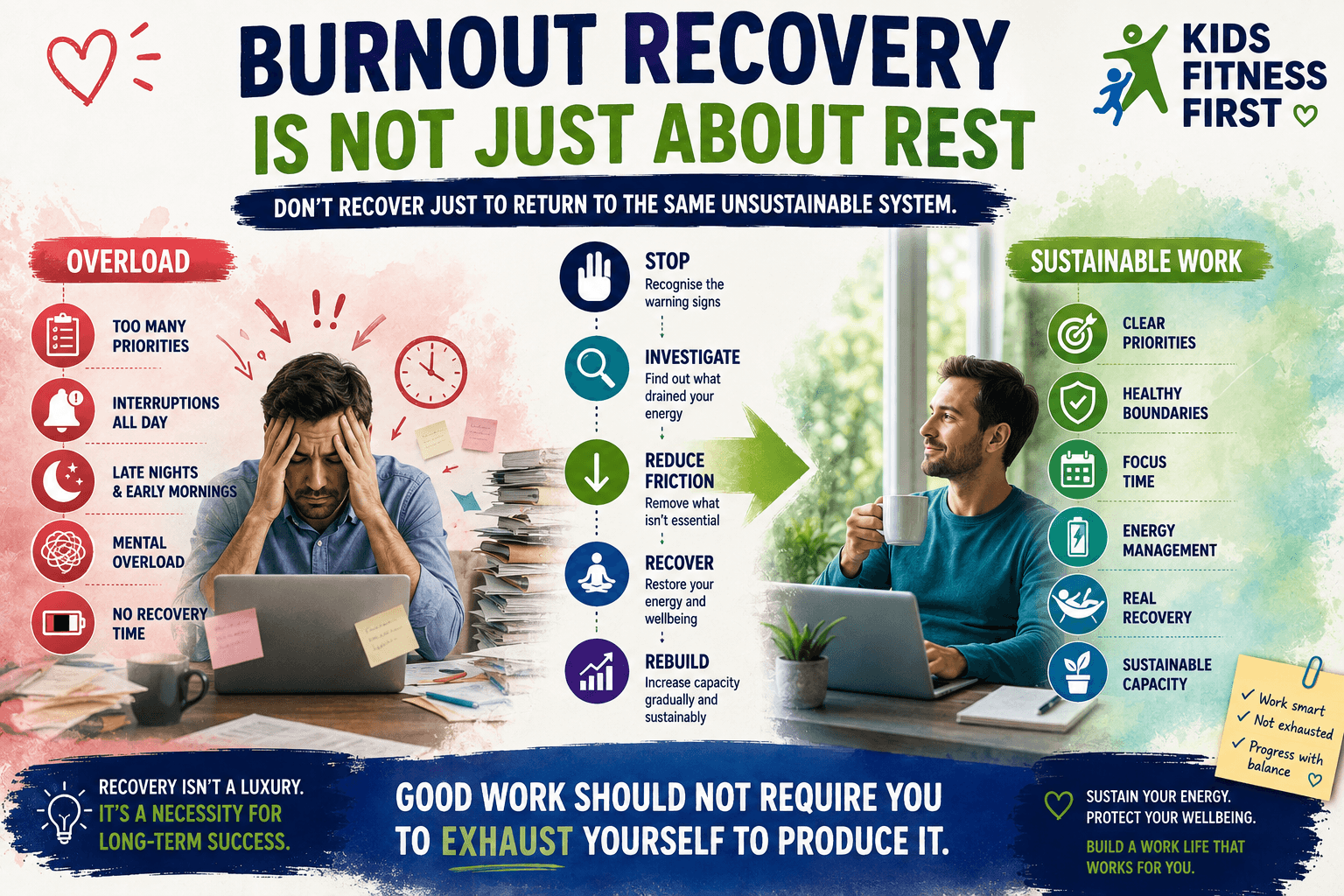
Adult ADHD and Burnout Recovery: How to Rebuild Energy Without Returning to the Same Working Pattern
Adult ADHD and burnout recovery can become complicated when the focus is placed only on rest.
Rest may be important.
However, if somebody rests and then returns to exactly the same conditions that contributed to overwhelming strain, the underlying problem may still be there.
For example, perhaps work involves constant interruptions.
Alternatively, priorities may change throughout the day.
Likewise, the employee may be compensating by working longer hours, checking everything repeatedly or taking unfinished work home.
Therefore, recovery should not ask only:
“How can I get my energy back?”
Instead, it may also be useful to ask:
“What was consuming so much energy in the first place?”
That question changes the direction of the conversation.
What Do We Mean by Burnout?
The word burnout is used widely.
Therefore, it is important not to use it as a diagnosis for every period of tiredness, stress or low motivation.
In general conversation, people may use burnout to describe a period of significant exhaustion or reduced capacity following prolonged demands.
However, persistent exhaustion, sleep problems, mood changes, concentration difficulties or reduced functioning can also have many other causes.
Therefore, significant or persistent symptoms deserve appropriate professional assessment rather than being automatically attributed to ADHD or work.
For this article, we will use burnout as a practical description of sustained work-related overload rather than as a medical diagnosis.
Adult ADHD and Burnout Recovery: Look at the Cost Behind Performance
Sometimes a person appears to be performing well.
Deadlines are met.
Emails are answered.
Meetings are attended.
The work gets finished.
However, the visible result may hide the cost required to produce it.
For example, perhaps the person:
works late every evening;
uses weekends to catch up;
checks work repeatedly;
cannot mentally switch off;
needs long periods to recover after work;
uses enormous effort to appear organised.
Therefore, performance alone does not always tell you whether the working pattern is sustainable.
Instead, ask:
“What does it cost me to maintain this level of performance?”
The Hidden Compensation Problem
Throughout Work That Fits, we have explored the difference between ability and environment.
A person may be capable of doing a job.
However, they may need excessive compensation to keep doing it.
For example:
poor task structure → constant self-reminding;
noisy environment → extreme concentration effort;
unclear priorities → repeated checking;
constant interruptions → working late to finish focused tasks;
poor systems → holding everything mentally.
As a result, the employee may still succeed.
However, the energy cost can become very high.
Adult ADHD and Burnout Recovery: The Performance Cost Equation
Think about work using this simple model:
PERFORMANCE IS NOT THE WHOLE STORY
Instead, consider:
OUTPUT + ENERGY COST + RECOVERY COST
Two people may produce the same output.
However, one may finish the working day with reasonable energy remaining.
Meanwhile, another may require the entire evening to recover.
Therefore, sustainable work should consider not only what you achieve but also what achieving it repeatedly costs.
Burnout Can Build Gradually
Burnout does not always arrive suddenly.
Instead, the pattern may develop slowly.
For example:
First, you work slightly later.
Then, you start using evenings to catch up.
Afterwards, weekends become recovery periods.
Meanwhile, ordinary tasks begin taking more effort.
Eventually, the working pattern may become difficult to sustain.
Therefore, early warning signs matter.
Adult ADHD and Burnout Recovery: Know Your Early Warning Signs
Your warning signs may include:
increasing procrastination;
difficulty starting simple tasks;
greater irritability;
more mistakes;
reduced patience;
constant mental fatigue;
loss of enthusiasm;
working longer for the same output;
difficulty switching off;
feeling overwhelmed by small demands.
However, these experiences are not specific to ADHD or burnout.
Therefore, they should be treated as signals to investigate rather than proof of a particular cause.
Build Your Personal Burnout Warning List
Write down the first signs that appear when work becomes unsustainable.
MY EARLY WARNING SIGNS
MY LATER WARNING SIGNS
Therefore, instead of noticing overload only when everything becomes difficult, you may begin recognising it earlier.
Adult ADHD and Burnout Recovery: Recovery Starts With Investigation
Before rebuilding your workload, investigate what happened.
Ask:
What changed?
When did things begin becoming difficult?
Which demands increased?
What recovery disappeared?
What were you compensating for?
What were you saying yes to?
What stopped working?
Therefore, burnout recovery becomes partly an investigation into the conditions surrounding the overload.
The Burnout Archaeology Exercise
Article 19 introduced Career Archaeology.
Now use the same method for burnout.
Create a timeline of the months before things became difficult.
For example:
MONTH 1
Workload increased.
MONTH 2
New manager introduced more meetings.
MONTH 3
Started working evenings.
MONTH 4
Exercise reduced.
MONTH 5
Sleep became less consistent.
MONTH 6
Routine tasks started feeling overwhelming.
As a result, you may see that burnout was not caused by one event.
Instead, several pressures may have accumulated.
Adult ADHD and Burnout Recovery: Identify the Load Stack
Think of demands as a stack.
For example:
WORKLOAD
Too many tasks.
COGNITIVE LOAD
Too many things to remember.
INTERRUPTION LOAD
Constant messages and questions.
SOCIAL LOAD
Too many meetings or interactions.
ENVIRONMENTAL LOAD
Noise, movement or unsuitable workspace.
EMOTIONAL LOAD
Conflict, uncertainty or pressure.
RECOVERY DEFICIT
Not enough genuine recovery.
One factor may be manageable.
However, several factors together can become much harder.
Therefore, examine the whole stack.
Not Every Problem Is Workload
Sometimes the obvious conclusion is:
“I have too much work.”
That may be true.
However, sometimes the amount of work is only part of the problem.
For example, ten tasks with clear priorities may feel manageable.
Meanwhile, six tasks with unclear priorities, constant interruption and repeated changes may feel overwhelming.
Therefore, examine both volume and friction.
Adult ADHD and Burnout Recovery: Workload Versus Work Friction
Use two columns.
| Workload | Work Friction |
|---|---|
| Number of tasks | Interruptions |
| Deadlines | Unclear instructions |
| Meetings | Poor systems |
| Projects | Constant switching |
| Responsibilities | Noise/distraction |
| Hours | Repeated checking |
Then ask:
“Is the main problem too much work, too much friction, or both?”
That distinction matters.
Remove Friction Before Adding More Effort
When performance drops, the instinct may be:
“I need to become more disciplined.”
However, if the system itself creates unnecessary friction, greater effort may only increase exhaustion.
Therefore, before pushing harder, ask:
“What could be simplified?”
For example:
fewer notification channels;
clearer priorities;
one task system;
shorter meetings;
protected focus periods.
As a result, some capacity may return without increasing effort.
Adult ADHD and Burnout Recovery: Stop Treating Recovery as Another Productivity Project
Recovery itself can become stressful.
For example:
wake at 5:30;
exercise;
meditate;
journal;
prepare perfect meals;
complete breathing exercises;
track everything.
Suddenly, recovery becomes another demanding schedule.
Therefore, avoid turning wellbeing into another performance competition.
Instead, begin with what is genuinely restorative and realistic.
Recovery Is Not Laziness
Periods of reduced capacity may require a temporary reduction in demands.
That does not automatically mean somebody lacks ambition.
Instead, it may reflect the reality that capacity is limited.
Therefore, the objective is not to prove toughness by ignoring exhaustion.
The objective is to rebuild sustainable capacity.
Adult ADHD and Burnout Recovery: Protect the Basics
When work becomes overwhelming, basic routines can sometimes deteriorate.
For example:
sleep becomes inconsistent;
meals become irregular;
movement disappears;
breaks disappear;
work extends into evenings.
Therefore, recovery may begin by restoring simple foundations.
However, persistent health symptoms should be discussed with an appropriate healthcare professional rather than managed solely through lifestyle changes.
Sleep and Recovery
Sleep can influence attention, energy and emotional regulation.
Therefore, repeatedly sacrificing sleep to complete work can create a difficult cycle.
For example:
unfinished work → work late → less sleep → lower next-day capacity → work takes longer → work late again.
As a result, the strategy intended to catch up may contribute to further difficulty.
Therefore, where possible, examine whether late working has become part of the problem.
Adult ADHD and Burnout Recovery: Movement Without Pressure
Movement may support general wellbeing.
However, during a difficult period, ambitious exercise targets may feel unrealistic.
Therefore, start with manageable activity appropriate to your circumstances.
For example:
a short walk;
gentle movement;
time outdoors;
stretching.
The goal is not to win a fitness challenge.
Instead, it is to support recovery in a sustainable way.
Reduce Decision Load
When energy is low, repeated small decisions can become surprisingly tiring.
For example:
What should I do first?
Which email matters?
When should I eat?
Which task should I continue?
Therefore, temporary simplification may help.
For example:
three daily priorities;
repeatable routines;
simple meals;
one task system;
planned communication windows.
As a result, fewer decisions compete for limited capacity.
Adult ADHD and Burnout Recovery: The Three-Priority Day
During recovery, a huge task list can create immediate pressure.
Instead, identify:
MUST
The most important task.
SHOULD
Important if capacity allows.
COULD
Useful but optional today.
Therefore, everything does not receive equal urgency.
This can reduce unnecessary cognitive pressure.
Rebuild Capacity Gradually
Suppose you have been operating at an unsustainable level.
Returning immediately to maximum workload may recreate the same problem.
Therefore, where circumstances allow, rebuild gradually.
For example:
STAGE 1
Essential responsibilities.
STAGE 2
Stable routine.
STAGE 3
Additional responsibilities.
STAGE 4
Higher-intensity work.
As a result, capacity can be tested rather than assumed.
Adult ADHD and Burnout Recovery: The Capacity Ladder
Create five levels.
LEVEL 1 — RECOVERY
Focus on essential demands and basic routines.
LEVEL 2 — STABILISATION
Re-establish predictable work patterns.
LEVEL 3 — REBUILD
Gradually increase focused work.
LEVEL 4 — NORMAL CAPACITY
Return to a sustainable regular workload.
LEVEL 5 — PEAK DEMAND
Short periods of unusually high demand when necessary.
The important point is this:
Level 5 should not become everyday life.
Peak Performance Is Not Everyday Performance
Article 11 explored your Peak Performance Formula.
Perhaps you can perform brilliantly under intense pressure.
However, that does not mean intense pressure should become your permanent working environment.
For example, sprinting may be useful occasionally.
You cannot necessarily sprint continuously.
Therefore, distinguish between:
what you can do temporarily
and:
what you can sustain repeatedly.
Adult ADHD and Burnout Recovery: Revisit Your Collapse Conditions
Article 12 identified Collapse Conditions.
Now ask:
Which of those conditions were present before burnout?
Perhaps:
constant interruption;
unclear priorities;
too much task switching;
poor sleep;
excessive social demand;
no recovery time.
Therefore, burnout recovery should include reducing the conditions already associated with difficulty.
Otherwise, the same pattern may return.
Revisit Your Work Environment Profile
Article 16 explored your Work Environment Profile.
Ask:
Was your environment increasing cognitive load?
For example:
open-plan noise;
constant movement;
digital interruptions;
lack of privacy.
If so, environmental changes may form part of recovery.
Therefore, recovery is not only something that happens inside the person.
Sometimes the environment needs attention too.
Adult ADHD and Burnout Recovery: Revisit Your Autonomy Profile
Article 18 explored autonomy.
Perhaps burnout developed partly because you had:
too little control;
too many competing demands;
constant unexpected changes.
Alternatively, perhaps you had too much autonomy without enough structure.
Therefore, recovery may require a better balance between freedom and external support.
Revisit Your Career Evidence
Article 19 asked you to examine your work history.
Now look specifically for previous overload patterns.
Ask:
“Has this happened before?”
If yes:
What was similar?
What was different?
What eventually helped?
Therefore, previous experience may provide useful clues.
Adult ADHD and Burnout Recovery: Use Workplace Accommodations
Article 21 explored workplace accommodations.
If certain barriers contributed to overload, practical adjustments may help.
For example:
written priorities;
protected focus time;
scheduled check-ins;
quieter workspace;
intermediate deadlines.
Therefore, burnout recovery does not necessarily mean simply resting outside work.
It may also mean redesigning parts of work itself.
Boundaries Are Part of Work Design
Burnout can sometimes involve boundaries gradually disappearing.
For example:
checking email at night;
replying immediately to every message;
accepting every task;
working through breaks;
taking work home.
Therefore, identify where work has expanded beyond its intended boundaries.
Adult ADHD and Burnout Recovery: The Boundary Audit
Ask:
When do I stop checking?
MESSAGES
What actually requires immediate response?
WORKING HOURS
When does the working day end?
BREAKS
Do I actually take them?
NEW TASKS
What happens when another priority is added?
WEEKENDS
Am I routinely using them to recover or catch up?
Therefore, boundaries become visible rather than assumed.
When Everything Is Priority One
A common workplace problem is priority inflation.
Everything becomes:
urgent;
critical;
immediate.
However, if everything is priority one, there is effectively no prioritisation.
Therefore, ask:
“If this new task becomes the priority, which existing task should move down?”
That simple question can prevent workload from expanding invisibly.
Adult ADHD and Burnout Recovery: Replace Addition With Substitution
Suppose your manager gives you another urgent task.
Instead of silently adding it to the workload, ask:
“Which current priority should this replace?”
Therefore:
new priority ≠ automatic additional workload.
Instead:
new priority = reordered workload.
This is a powerful distinction.
The Energy Budget
Money has a budget.
Time has a budget.
Energy also has limits.
Therefore, imagine that you begin each day with an Energy Budget.
Some tasks cost more than others.
For example:
complex meeting — high cost;
deep analysis — high cost;
routine email — lower cost;
conflict — very high cost.
Therefore, avoid scheduling every high-cost task together where possible.
Adult ADHD and Burnout Recovery: Track Energy, Not Just Time
For one week, record:
| Activity | Time | Energy Before | Energy After |
|---|---|---|---|
| Meeting | 60 min | 7/10 | 4/10 |
| Analysis | 90 min | 8/10 | 6/10 |
| Admin | 45 min | 5/10 | 3/10 |
Then examine the pattern.
Perhaps certain activities consistently create disproportionate exhaustion.
Therefore, workload planning can consider energy as well as hours.
Find Your Energy Leaks
An Energy Leak is something that repeatedly consumes effort without creating enough value.
For example:
unnecessary meetings;
duplicated administration;
constant notifications;
unclear tasks;
repeatedly searching for information;
poorly organised systems.
Therefore, ask:
“Which parts of my working day consume energy without meaningfully improving the result?”
Those are strong candidates for redesign.
Adult ADHD and Burnout Recovery: Stop Carrying Work in Your Head
Open loops consume attention.
For example:
remember to call Sarah;
finish report;
reply to manager;
order equipment.
Therefore, use an external system.
Write it down.
Schedule it.
Assign it.
Then stop repeatedly reminding yourself mentally.
As a result, working memory does not have to function as a permanent task-management system.
Reduce Open Loops
At the end of each working day, spend a few minutes recording:
what is unfinished;
what happens next;
when it will be addressed.
For example:
Supplier quote — waiting for reply — review Wednesday.
Therefore, unfinished work becomes contained.
You do not need to solve everything before leaving work.
Adult ADHD and Burnout Recovery: Create a Shutdown Routine
A short shutdown routine can help create a clearer boundary.
For example:
STEP 1
Review unfinished work.
STEP 2
Choose tomorrow’s first priority.
STEP 3
Record anything you are worried about forgetting.
STEP 4
Close work systems.
STEP 5
End the working day.
Therefore, tomorrow has a starting point while today has an ending point.
Recovery Requires Real Recovery
Scrolling, checking messages and thinking about work may feel like stopping.
However, they may not always provide meaningful psychological distance from work.
Therefore, identify activities that genuinely help you disengage.
For example:
walking;
exercise;
music;
hobbies;
time outdoors;
social connection;
quiet time.
Different people recover differently.
Therefore, discover what actually restores you.
Adult ADHD and Burnout Recovery: Your Recovery Menu
Create three categories.
5-MINUTE RECOVERY
Short walk.
Stretch.
Step outside.
30-MINUTE RECOVERY
Walk.
Exercise.
Music.
Hobby.
DEEPER RECOVERY
Longer time away from work.
Social connection.
Outdoor activity.
Meaningful hobby.
Therefore, when capacity is low, you have options rather than needing to invent a recovery strategy in the moment.
Do Not Confuse Stimulation With Recovery
An activity can be enjoyable without necessarily being restorative.
For example, highly stimulating digital activity may feel engaging.
However, afterwards you may not feel more recovered.
Therefore, ask:
“How do I feel after this activity?”
rather than only:
“Do I enjoy this activity?”
That distinction can help identify genuine recovery.
Adult ADHD and Burnout Recovery: The Recovery Score
After a recovery activity, score:
ENERGY BEFORE
__/10
ENERGY AFTER
__/10
MENTAL CALM BEFORE
__/10
MENTAL CALM AFTER
__/10
Over time, patterns may emerge.
Therefore, recovery can become personalised rather than based on generic advice.
Beware the Catch-Up Cycle
The catch-up cycle can look like this:
fall behind;
work longer;
sleep less;
capacity drops;
fall further behind;
work even longer.
Therefore, simply adding hours may sometimes worsen the underlying problem.
Instead, ask whether:
priorities;
workload;
systems;
environment;
support
also need to change.
Adult ADHD and Burnout Recovery: Productivity May Temporarily Drop
Recovery may involve accepting that output cannot immediately return to its previous maximum.
That can feel uncomfortable.
However, forcing maximum output before capacity has recovered may create another setback.
Therefore, where circumstances allow, focus first on stable performance.
Then increase demand gradually.
Consistency Before Intensity
A useful recovery principle is:
CONSISTENCY BEFORE INTENSITY
For example, it may be better to complete four sustainable working days than repeatedly alternate between extreme productivity and collapse.
Therefore, measure success by stability as well as output.
Adult ADHD and Burnout Recovery: The 70% Question
Ask:
“What would working at a sustainable 70% feel like?”
This is not a scientific percentage.
Instead, it is a reflection exercise.
Perhaps it means:
fewer late evenings;
more realistic deadlines;
one less major commitment;
protected breaks;
less unnecessary perfectionism.
Therefore, consider whether constantly operating at perceived maximum capacity has become normal.
Perfectionism Can Increase the Cost
Sometimes the task is complete.
However, you continue refining it.
Then refining it again.
Therefore, ask:
“What standard does this task actually require?”
Not every email needs to be perfect.
Likewise, not every presentation needs ten revisions.
As a result, matching effort to importance can conserve capacity.
Adult ADHD and Burnout Recovery: Define Good Enough
Before starting a task, define:
What does finished look like?
For example:
HIGH-STAKES REPORT
Requires detailed checking.
INTERNAL EMAIL
Clear and accurate is enough.
EARLY DRAFT
Does not need polishing.
Therefore, quality remains appropriate without applying maximum effort to everything.
Recovery at Work Versus Recovery From Work
These are different.
RECOVERY AT WORK
Short breaks;
better task structure;
lower interruption;
reasonable workload.
RECOVERY FROM WORK
Sleep;
time away;
movement;
relationships;
hobbies.
Therefore, a sustainable system may need both.
Excellent evenings cannot completely compensate for a continuously unsustainable workplace.
Adult ADHD and Burnout Recovery: When the Job Itself May Need Examination
Sometimes adjustments help significantly.
However, sometimes the deeper problem is the role itself.
For example, perhaps the job consistently requires the exact conditions that repeatedly appear in your Collapse Conditions.
If so, ask:
“Am I trying to recover so that I can return to a fundamentally unsuitable working pattern?”
That is a difficult question.
However, it may be important.
Recovery Is Not Always About Returning
Sometimes recovery leads back to the same role with better systems.
Alternatively, it may lead to:
different responsibilities;
different hours;
different environment;
different employer;
different career direction.
Therefore, recovery does not automatically mean restoring the previous situation exactly as it was.
It may mean building something more sustainable.
Adult ADHD and Burnout Recovery: The Burnout Recovery Map
Create four sections.
1. WHAT DRAINED ME?
2. WHAT WAS I COMPENSATING FOR?
3. WHAT NEEDS TO CHANGE?
4. WHAT HELPS ME RECOVER?
Then identify your three highest-priority changes.
This becomes your Burnout Recovery Map.
The Return-to-Work Filter
Before adding a responsibility back, ask:
Is it essential?
Is my capacity stable enough?
Can it be structured differently?
What warning signs should I watch?
What will I reduce if this is added?
Therefore, responsibilities return deliberately rather than automatically.
Adult ADHD and Burnout Recovery: Green, Amber and Red Capacity
GREEN — STABLE
You can complete normal responsibilities while maintaining reasonable recovery.
Therefore, gradual progression may be appropriate.
AMBER — STRAINED
Work is being completed.
However, recovery cost is rising.
Therefore, investigate early.
RED — UNSUSTAINABLE
Basic functioning or wellbeing is significantly affected, or symptoms are severe or persistent.
Therefore, reduce assumptions about self-management and seek appropriate professional support.
Your 7-Day Energy Audit
For seven days, record:
MORNING ENERGY
__/10
MIDDAY ENERGY
__/10
END-OF-WORK ENERGY
__/10
BIGGEST ENERGY DRAIN
BIGGEST ENERGY SUPPORT
WORK FINISHED ON TIME?
Yes / No
WORK CONTINUED INTO PERSONAL TIME?
Yes / No
At the end of seven days, examine the pattern.
Therefore, you begin working with evidence rather than memory alone.
Adult ADHD and Burnout Recovery: Create Your Prevention Plan
Recovery should eventually become prevention.
Complete:
MY THREE EARLY WARNING SIGNS
MY THREE BIGGEST WORKPLACE DRAINS
MY THREE MOST EFFECTIVE RECOVERY METHODS
WHEN WARNING SIGNS APPEAR, I WILL…
This becomes your Burnout Prevention Plan.
Connect Article 22 to the Work That Fits Framework
By Article 22, your framework now contains:
Cognitive Signature
How you naturally work and think.
Peak Performance Formula
Conditions associated with strong performance.
Collapse Conditions
Conditions associated with difficulty.
Strength Portfolio
Where your abilities create value.
Depth Portfolio
Where deeper expertise creates value.
Automation Boundary
Where technology should support rather than replace judgement.
Work Environment Profile
Which surroundings support your performance.
Open-Plan Balance
How you balance collaboration and concentration.
Autonomy Profile
How much control and structure support you.
Career Evidence File
What your work history reveals.
Disclosure Planning Sheet
How to communicate workplace needs.
Accommodation Planning Sheet
How to test practical workplace changes.
Burnout Recovery Map
What drained capacity and what needs to change.
Burnout Prevention Plan
How to recognise and respond to warning signs earlier.
Therefore, the framework is no longer concerned only with finding work that fits.
It is also concerned with making that work sustainable.
Reflection Questions
- What does your current performance cost you?
- Are you regularly using evenings or weekends to compensate for work?
- What were your earliest signs of overload?
- Which demands increased before things became difficult?
- Is the problem workload, work friction or both?
- Which Collapse Conditions are currently present?
- Which workplace accommodation could remove the largest barrier?
- Which activities genuinely restore your energy?
- What boundaries have gradually disappeared?
- Are you treating every task as equally important?
- What could you temporarily reduce while rebuilding capacity?
- Are you trying to recover for a working pattern that was never sustainable?
Conclusion: Do Not Recover Just to Repeat the Same Cycle
Adult ADHD and burnout recovery should not be reduced to:
rest → recover → return → repeat.
Instead, recovery can become an opportunity to investigate the entire system.
First, identify what drained your capacity.
Then examine the hidden compensation behind your performance.
Next, distinguish workload from unnecessary work friction.
Afterwards, restore basic routines and rebuild capacity gradually.
Meanwhile, review your boundaries, environment, autonomy and workplace support.
Finally, create an early-warning and prevention plan.
Therefore, the objective is not simply to become capable of tolerating the old system again.
The objective is to build a better one.
Most importantly:
DO NOT MEASURE SUCCESS ONLY BY HOW MUCH WORK YOU CAN SURVIVE.
Instead, ask:
“CAN I DO GOOD WORK AND STILL HAVE ENOUGH OF MYSELF LEFT FOR THE REST OF MY LIFE?”
Because sustainable performance is not simply about producing more.
It is about creating a way of working that you can realistically continue.
SUGGESTED INTERNAL LINKS
Link Article 22 naturally to:
- Adult ADHD and Workplace Accommodations: Practical Changes That May Help You Work More Effectively
- Adult ADHD and Disclosure at Work: How to Decide Whether to Tell Your Employer
DISCLAIMER
This article is provided for general educational and informational purposes only. It does not provide medical, psychological, diagnostic, occupational-health, employment or legal advice.
Burnout-like symptoms, exhaustion, concentration difficulties, sleep changes and reduced functioning can have many possible causes. Therefore, they should not automatically be attributed to ADHD, burnout or workplace circumstances.
Likewise, ADHD experiences vary considerably between individuals.
If exhaustion, mood changes, sleep problems, reduced functioning or other symptoms are significant, persistent, worsening or concerning, seek appropriate professional healthcare advice.
Workplace changes and return-to-work arrangements should also be considered according to individual circumstances and, where appropriate, with relevant occupational-health, employment or professional guidance.